
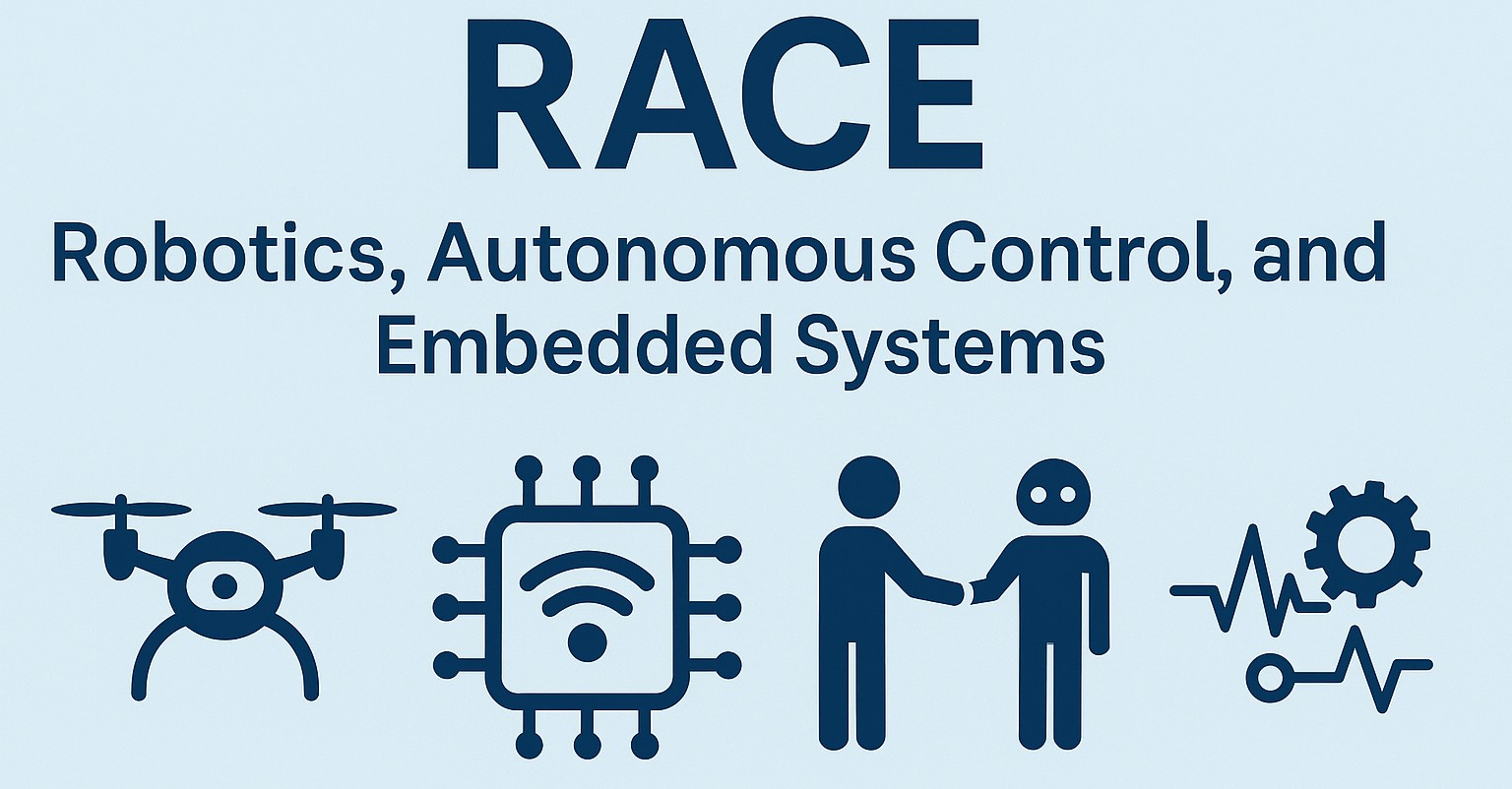
RACE (Robotics, Autonomous Control, and Embedded Systems)
Core Competencies:
- Autonomous Systems and Robotics
- Embedded Systems and Internet of Things (IoT)
- Human-Robot Interaction (HRI)
- Mechatronic System Design and Control Systems
Description:
The RACE research group is dedicated to the development of autonomous systems, robotics, and intelligent embedded systems. The group focuses on innovations in flight control, robotics, and real-time embedded computing. Their research extends to areas like path planning for mobile robots, autonomous navigation, and human-robot collaboration, with applications in aerospace, industrial automation, and smart systems.
Group Members:
- Zohaib Ahmad (PI: Principal Investigator)
- Raja Farrukh Ali (Co-PI: Co-Principal Investigator)
- Salahuddin
- Salman Khan
- Fazal ur Rehman
Ancillary Members
- Ammar Saleem
- Dr Ali Iqbal
- Muhammad Rizwan
- Muhammad Amir Tahir
Member Profiles
- Ammar Saleem. Ammar Saleem received the B.E. degree in Avionics engineering from the National University of Sciences and Technology, Pakistan, in 2007, M.Sc. degree in Avionics engineering from Air University, Islamabad, Pakistan, in 2013, and Ph.D. degree in electronics engineering from Sabanci University, Türkiye. His research interests include solving inverse problems, machine learning, radar signal processing, and communication resource management.
- Zohaib Ahmad Khan: Dr. Khan specializes in signal processing and adaptive systems, particularly self-mixing laser interferometry. His research applies AI and mathematics to improve radar signal processing for autonomous systems.
- Raja Farrukh Ali: Ali completed his PhD in Computer Science from Kansas State University, USA. He specializes in machine learning and reinforcement learning, applying these techniques to autonomous systems, avionics simulations, and virtual reality-based AI training systems.
- Salahuddin: Salahuddin received in Bachelor and Master’s Degree from National University of Sciences & Technology (NUST) in Avionics Engineering 2009 and Electrical Engineering in 2017 respectively. His research interests include steganography via machine learning, image processing and computer vision.
- Muhammad Rizwan: Muhammad Rizwan received his Bachelor’s degree from National University of Sciences & Technology (NUST), Pakistan in Avionics Engineering (2011) and Master’s Degree from Air University (AU), Pakistan in Information Security (2022). His research interests encompass information security, cryptography, tactical data links emphasizing physical layer transmission security, digital signal processing, and embedded system security.
- Muhammad Amir Tahir: Muhammad Amir Tahir received his bachelor’s and Masters’s degree in Avionics engineering from the College of Aeronautical Engineering, National University of Sciences and Technology (NUST), Pakistan, in 2015 and 2023 respectively. His research interests include flight simulations and guidance, navigation and control for unmanned aerial vehicles.
- Salman Khan: Mr. Khan focuses on robotics and control systems, with research interests in mobile robot path planning, AI-driven autonomous systems, and advanced signal processing for robotics.
- Fazal ur Rehman: Mr. Rehman works on robotics and computer vision, with expertise in IoT-enabled embedded systems and artificial intelligence. His research covers human-robot interaction and the design of mechatronic systems.
Publications
- Tahir, Muhammad Amir, Imran Mir, and Tauqeer Ul Islam. “A review of UAV platforms for autonomous applications: comprehensive analysis and future directions.” IEEE Access 11 (2023): 52540-52554.
- Mir, Imran, Muhammad Amir Tahir, and Suleman Mir. “A Perspective Analysis of UAV Flight Control Architecture Incorporating Ground Control Stations and Near‐Actual Techniques.” Unmanned Aircraft Systems (2024): 519-561.
- Hakeem, Bakhtiar, Muhammad Taimoor, and Muhammad Amir Tahir. “A Review of Fixed Wing Unmanned Aerial Vehicles: Control Methodologies for Rejecting Unwanted Disturbances during Landing.” In 2024 4th International Conference on Digital Futures and Transformative Technologies (ICoDT2), pp. 1-8. IEEE, 2024.
- Khalil, M. S. Ikram and A. Shah, “SonicVision: Navigating Object Counting Frontiers with Ultrasonic Economy,” 2024 4th International Conference on Innovations in Computer Science (ICONICS), Karachi, Pakistan, 2024, pp. 1-6,
- Khalil and S. A. Sheikh, “Advancing Green Energy Integration in Power Systems for Enhanced Sustainability: A Review,” in IEEE Access, vol. 12, pp. 151669-151692, 2024.
- A. Khan, U. Zabit, O. D. Bernal, M. O. Ullah and T. Bosch, “Adaptive Cancellation of Parasitic Vibrations Affecting a Self-Mixing Interferometric Laser Sensor,” in IEEE Transactions on Instrumentation and Measurement, vol. 66, no. 2, pp. 332-339, Feb.2017.
- A. Khan, U. Zabit, O. D. Bernal and T. Hussain, “Adaptive Estimation and Reduction of Noises Affecting a Self-Mixing Interferometric Laser Sensor,” in IEEE Sensors Journal, vol. 20, no. 17, pp. 9806-9815, 1 Sept.1, 2020, doi:10.1109/JSEN.2020.2992848.
- Zohaib A Khan, Tassadaq Hussain, Usman Zabit, Muhammad Usman, Eduard Ayguade,”PH‐RLS: A parallel hybrid recursive least square algorithm for self‐mixing interferometric laser sensor”, IET Optoelectronics, 2021.
- Muhammad Sadiq Orakzai, Saqib Amin, Zohaib Ahmad Khan, Faraz Akram, “Fast and highly accurate estimation of feedback coupling factor and linewidth enhancement factor for displacement sensing under different feedback regimes” in Optics Communications, Volume 508, 2022, 127751.
- Muhammad Sadiq Orakzai, Saqib Amin, Zohaib Ahmad Khan, Faraz Akram, “Fast and highly accurate phase unwrapping algorithm for displacement retrieval using self-mixing interferometry sensor”, Optical Materials, Volume 129, 2022, 112553, ISSN 0925-3467
- Ali, Zohaib. A. Khan, T. Senapati and S. Moslem, “Frank-Based TOPSIS Methodology of Development and Operations Challenges Based on Intuitionistic Linguistic Aggregation Operators and Their Applications,” in IEEE Access, vol. 12, pp. 91605-91618, 2024, doi: 10.1109/ACCESS.2024.3420711.
- Saqib Amin, Muhammad Sadiq Orakzai, and Zohaib Ahmed Khan, “Simple and high-resolution method for displacement sensing using self-mixing interferometry,” Opt. Continuum 3, 2116-2126 (2024)
- A. Khan, M Sadiq, Saqib, Faraz Akram “Li-Fi Based Healthcare Monitoring System”, PakJET, vol. 5, no. 2, pp. 177-182, Sep. 2022.
- R. Z. Hamdani, M. Tahir, F. Akram, M. S. Orakzai, S. Amin, and Zohaib. A. Khan, “Designing A Non-Invasive Testing Device for Infant Diabetes using Saliva”, PakJET, vol. 5, no. 2, pp. 193-197, Sep. 2022.
- A. Khan, Akram, F., Amin, S., Orakzai, M. S., Muhammad, A. M., Naseer, Z. B., (2023). Design and Fabrication of Heart Rate and Oxygen Saturation Measurement Device using LED-LED Configuration and to Study Correlation of PPG Signal Amplitude with Breathing Rate. Pakistan Journal of Scientific Research, 2023,3(1), 113–118
- Nawaz, H., Zohaib. A.Khan, Zahra, S. T., Amin, S., Basheer, Y., Ali, Z., Akram, F., & Orakzai, M. S. (2023). IoT Based Load Management Control and Theft Protection from DISCO’s Side. International Journal of Emerging Engineering and Technology,2023, 2(1), 63–68
- Ali,R Nawaz, M Sadiq, Saqib, Zohaib . A. Khan, Faraz Akram “Solar Powered Smart Irrigation System”, PakJET, vol. 5, no. 1, pp. 49-55, Mar. 2022.
- F Ajaz, M Shahzad, Zohaib A Khan, “WSN-Based Fire, Smoke & Natural Gas Outflow Detection and Prevention System” in LC International Journal of STEM (ISSN: 2708-7123), Vol. 1No. 4 (2020): Oct – Dec 2020.
PG / UG Student Members (last 03 years)
- Syed Mohammad Zubair Ali (MS Electrical Engineering, CAE)
- Muhammad Muzamal Shahzad (MS Electrical Engineering, CAE)
- Jahanzeb Khan (MS Electrical Engineering, CAE)
- Amir Tahir (MS Electrical Engineering, CAE)
- Bakhtiar Hakeem (MS Electrical Engineering, CAE)
- Shah Fahad(BE Avionics Engineering, CAE)
Projects / Thesis (Completed + Ongoing)
- Thesis: Adaptive Reduction of Noise Affecting Self-Mixing Laser Interferometric Displacement Sensor Based on (Filtered x Least Mean Square) FxLMS. Student: Nadeem Ahmed, Supervisor Dr. Zohaib Ahmad Khan. Status: Ongoing.
- Thesis: Low cost dynamic body weight support system with inertia compensation for physiotherapy rehabilitation of patients with walking disabilities (Syed Mohammad Zubair Ali Supervised by Dr Hammad Munawar, 2022)
- Thesis: Design and analysis of swarm intelligence algorithms for implementing the collective behaviour of autonomous robots (Student: Muhammad Muzamal Shahzad, Supervised by Dr Qasim Ali, 2022)
- Thesis: Cooperative Control Scheme of a Multi UAV System (Student: Jehanzeb Khan, Supervised by Dr Qasim Ali, 2022)
- Thesis: Conceptual Design & Development of Guidance, Navigation and Control (GNC) Strategies for various Flight Phases of Aerial Vehicle (Student: Amir Tahir, Supervised by Dr Imran Mir, 2023)
- Project: 4-DoF Robotic arm for drawing – Phase – 1 Student (Supervised by Ammar Saleem, 2025)
Funding
- None
Collaboration (Academia / Industry)
- None
Equipment & Resources
- Lego Mindstorm EV3 31313
- QLabs Virtual Qube-Servo 3
- TurtleBot3
- Drone Arena (20′ x 20′)
- Thrustmaster HOTAS Warthog Flight Stick, Throttle and Control Panel for Flight Simulation
Competitions
- 2020 – National Flying Competition (NFC), 2020. 1st (drone demonstration), 2nd (Hell in a Cell), 2nd (Battle of Drones).
- 2022 – National Engineering and Robotics Contest (NERC) held at EME, NUST. 1st position taken by MS Student Zubair Ali.
- 2023 – International Space and Scientific Payload Competition, Beijing Institute of Technology, China. 3rd Prize won by Project Saf Shikan. A combined team of Aero and Ave participated in the competition (95B students)
- 2023 – National Students Convention (NaSCon’23) 1st Position. A combined team of Aero and Ave participated in the competition.